
Amsterdam: Where the Canals Connect More Than a City
There is something rather poetic about landing in Amsterdam on your birthday.
Another trip around the sun, and there I was beginning another trip around the world.
Amsterdam was the first stop on my latest three-country adventure: the Netherlands, France and Belgium. We stayed at the Mr. Jordaan Hotel in Amsterdam's Jordaan neighborhood, tucked into one of the city's most charming areas and still close enough to the canals that the Amsterdam I had pictured in my mind was waiting just outside the door.
I didn't know a great deal about Amsterdam before I arrived. I knew about the canals. I knew about the bicycles. And, of course, I knew about the coffee shops.
Although here's an important Amsterdam travel tip:
If you're actually looking for coffee, make sure you're walking into a café, not necessarily a "coffee shop."
Those two words can provide very different afternoon experiences in Amsterdam.
Coffee culture itself has deep roots here. Amsterdam became an important European center for the coffee and tea trade in the 17th century, and today cafés remain places where people linger rather than simply grab a cup and rush away. I amsterdam
And lingering seems to be something Europeans do exceptionally well.
A City Built for Gathering
One of the things I continue to notice as I travel through Europe is how cities are designed around gathering.
There are squares where people sit in the sunshine.
Outdoor tables spill onto sidewalks and along canals.
Farmers markets pop up.
Festivals take over public spaces.
Neighbors stop for coffee.
People walk to the grocery store, ride bicycles to work and hop on public transportation rather than getting into a car every time they leave home.
It creates a kind of intimacy that surprises me in a large city.
Amsterdam has more than 400 kilometers of cycling lanes, and walking, biking and public transportation are woven deeply into everyday life here.
The homes are often smaller. Cars and parking are expensive and impractical. So instead of living almost entirely inside our homes, people seem to live more of their lives out in the community.
And I kept thinking:
Maybe community isn't something we have to manufacture.
Maybe sometimes we simply have to design places that allow it to happen.
That's one of the differences I often feel between European cities and many American neighborhoods.
The American City That Comes Closest for Me
I've lived in Las Vegas, Orlando and Chicago, and Chicago is probably the closest I've come in the United States to experiencing that same rhythm.
When I lived there, we walked to work and walked home.
We could stop at the little grocery store in the lower level of our building and pick up a fresh salad for dinner.
I used public transportation both above ground and below it.
And because the apartment itself was small, life happened outside of it.
Friday night comedy.
Tuesday movies.
Museums.
Theater productions.
Restaurants.
Walking.
Exploring.
Chicago made the city feel almost like an extension of your living room.
Amsterdam gave me that same feeling.
I loved my views when I lived in Chicago, but unfortunately, the elevators did not love me back. I worked on the 26th floor and lived on the 22nd, and eventually developed a severe case of vertigo.
So I traded my skyscraper views for something a little closer to sea level.
Which brings me to another observation about Europe.
European Elevators: An Intimacy Exercise
You really get to know your traveling companion when the hotel elevator is barely large enough for two people and two suitcases.
Some European elevators feel less like transportation and more like a relationship-building exercise.
I have found myself feeling just claustrophobic enough that, on occasion, I will put my suitcase into the elevator and say:
"I'll meet you upstairs."
And take the stairs.
Travel teaches you things about yourself.
Apparently, one of the things I've learned about myself is that I am perfectly willing to let my luggage ride alone.
Seeing Amsterdam From the Water
My favorite experience in Amsterdam was our sunset canal cruise.
Unfortunately, we sat near the back of the boat where the ship-to-shore radio repeatedly interrupted our guide's commentary, so I probably missed half of the fascinating history being shared.
But the view made up for it.
Watching Amsterdam glide past from the water helped me understand the city in an entirely different way.
Those canals aren't merely picturesque. Amsterdam's famous canal ring was an extraordinary feat of urban planning and hydraulic engineering developed primarily during the 17th century. The concentric network of waterways helped create an entirely new port city, and the historic canal ring was added to the UNESCO World Heritage List in 2010. UNESCO World Heritage Centre
The Jordaan itself began developing in the early 1600s as a more working-class neighborhood beside the grand canal belt. Today it is one of Amsterdam's best-known neighborhoods, filled with narrow streets, galleries, restaurants and those unmistakable Dutch canal houses. UNESCO World Heritage Centre
From the boat I found myself studying those houses.
Tall.
Narrow.
Sometimes leaning slightly.
Each one different from the next.
And yet together they created this extraordinarily cohesive cityscape.
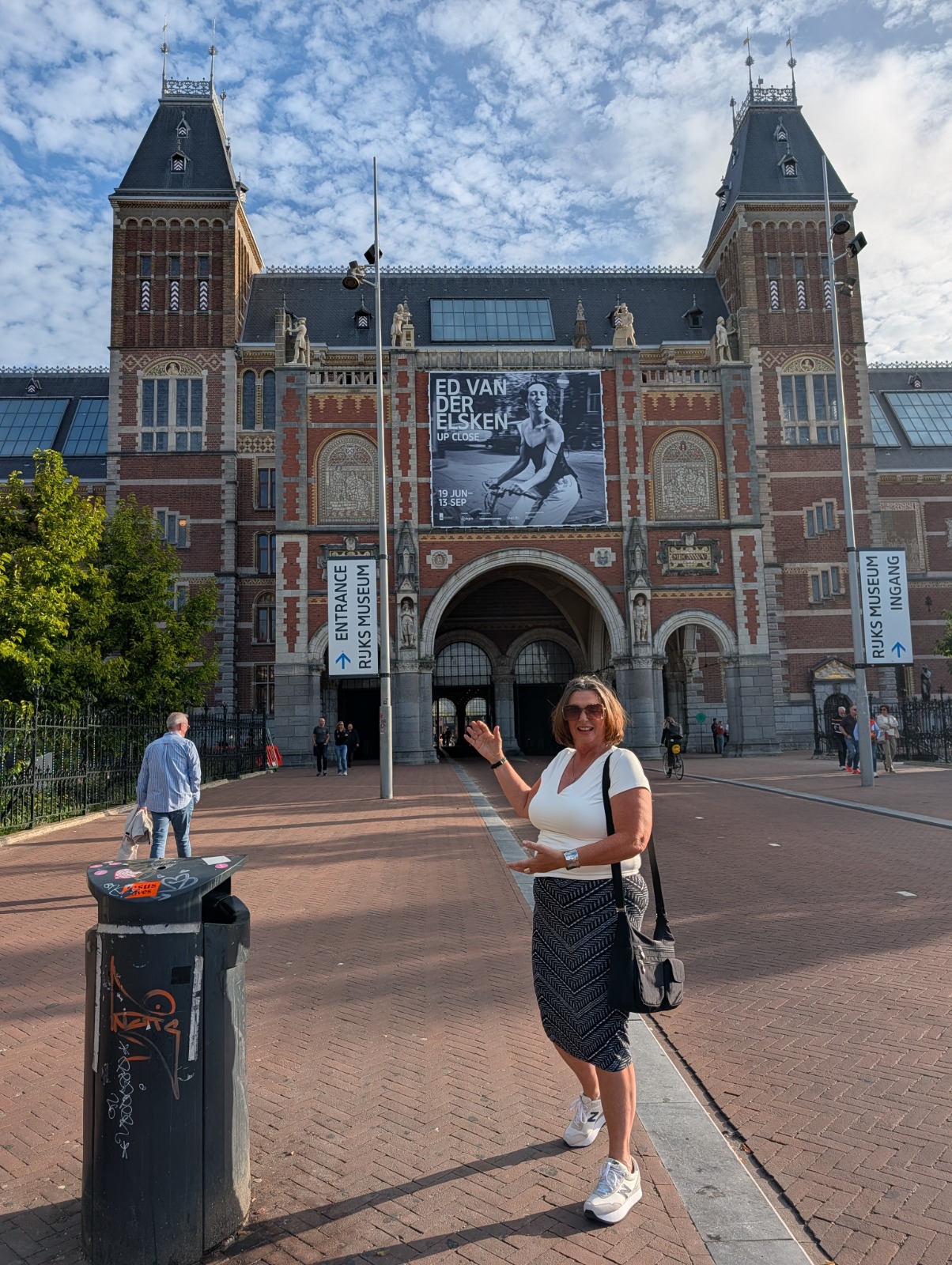
The awe of the Rijksmuseum Museum and the emotions after a visit to the Ann Frank House all stir something inside me. That's something Europe does beautifully: preserving individuality without losing a sense of place.
The Canals Were Why I Came
Part of my fascination with Amsterdam actually started years earlier while watching a British television program about a couple living aboard a longboat and spending their days traveling through canals.
Something about that life intrigued me.
Wake up.
Untie the boat.
Float somewhere new.
Tie up again.
Explore.
Repeat.
For someone who has spent the last few years redefining what "home" means, I suppose it isn't surprising that the idea appealed to me.
So finally being on Amsterdam's canals felt a little like stepping inside something I had watched from a distance for years.
And Yes, I Went to the Red Light District
Of course I did.
I couldn't go to Amsterdam without walking through the famous Red Light District.
In my imagination, it had become something mysterious, provocative and slightly scandalous.
The reality, at least when we walked through around dusk, was much less dramatic than the version I had created in my head.
I'm sure the atmosphere changes substantially later in the evening.
But curiosity is one of the reasons I travel.
Amsterdam's Red Light District is known locally as De Wallen, and it's actually the oldest part of the city. That's one of the fascinating contradictions of Amsterdam: centuries-old churches, crooked canal houses, restaurants, museums and legalized sex work all occupying the same few streets. Amsterdam's oldest building, the Oude Kerk, sits right in the heart of the district. I amsterdam
I find that juxtaposition fascinating.
History rarely fits into the tidy boxes we create for it.
Neither do cities.
Neither do people.
Perhaps That's What I Loved About Amsterdam
Amsterdam is full of contrasts.
Historic and progressive.
Crowded and intimate.
Urban yet somehow village-like.
Beautiful canal homes sitting beside modern businesses.
Ancient churches neighboring one of the most famous nightlife districts in the world.
Thousands of people moving around the city, yet still making time to sit at an outdoor table and watch the afternoon go by.
And maybe that's what stayed with me most.
I arrived thinking Amsterdam would be about canals.
I left thinking about connection.
When we walk instead of drive, we see one another.
When homes are smaller, we use our neighborhoods more.
When cities give us parks, squares, cafés, markets and public transportation, strangers repeatedly cross paths until they aren't quite strangers anymore.
Perhaps some of what we're missing isn't another social network.
Maybe it's simply a good town square, a table outside a café and enough time to linger.
That was my bit of insight from Amsterdam.


Mail
Facebook
LinkedIn
X
Pinterest